Camera/Video Terminology
1. Introduction
Here, we’ll cover the basic terminology you’ll need to get started with live-action video shooting and editing. Since there are many other technical terms and industry-specific terms beyond those covered here, please also refer to the following websites.
- Canon Official - Photography Glossary
- What’s the Difference Between Mirrorless, DSLR, and Smartphone Cameras? A Comparison of Pros and Cons
- University of Camera
- [User Guide Vol. 1] Mastering Your Mirrorless Camera!
- [User Guide Vol. 2] Essential Techniques and Tips for Shooting Video
2. Types and Structure of Cameras
2.1 Single-Lens Reflex Cameras (Digital/Film)
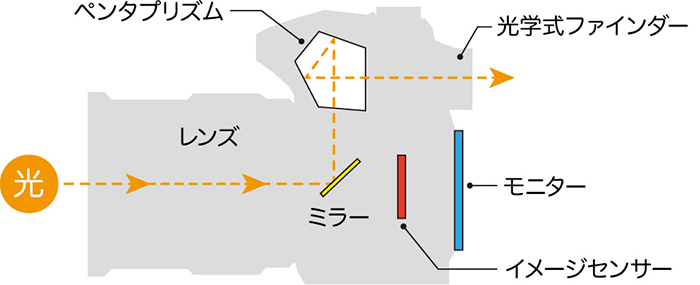
The pentaprism and mirror allow the same image as the lens to be projected into the viewfinder. Originally available only in film formats, these cameras were digitized with the advent of digital technology. Because of the mechanisms required to flip up the pentaprism and mirror, many of these cameras were expensive and were marketed primarily as professional models. Digital single-lens reflex cameras are commonly referred to as DSLRs, an abbreviation of “Digital Single-Lens Reflex Camera” (Wikipedia).
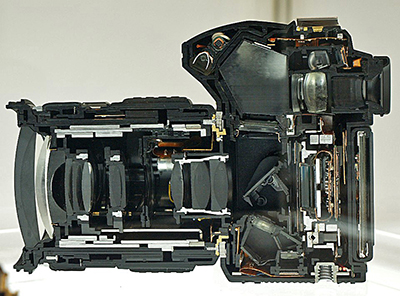
The figure below shows a cross-section of the Olympus E-30.
2.2 Mirrorless Digital Cameras
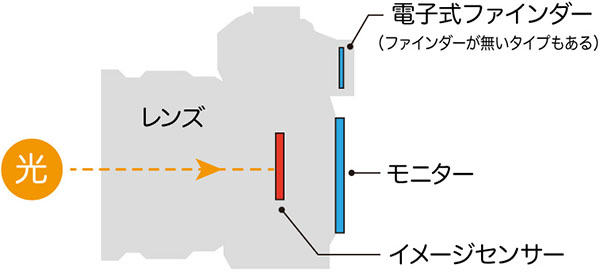
A camera that uses an electronic viewfinder, similar to its monitor. It emerged as the image quality of LCD monitors and electronic viewfinders improved. It is called a “mirrorless” camera because it lacks the pentaprism and mirror (Reflex) found in SLR cameras. It offers advantages such as a compact, lightweight design and the ability to shoot silently.Models that feature only a rear monitor and lack a viewfinder are also classified as mirrorless cameras. Initially, there was a difference in image quality compared to SLRs because the CCD size was smaller, but in recent years, the adoption of full-frame CCDs has eliminated this gap. As a result, mirrorless cameras have become the mainstream choice even for professional use, surpassing SLRs.
2.3 Rangefinder Cameras (Film)
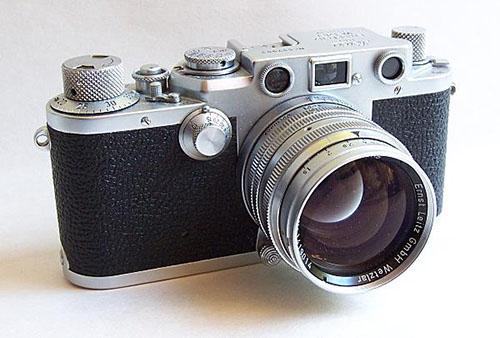
Unlike SLR cameras, these models do not have a pentaprism or mirror, which reduces camera shake and noise during shutter release. This allows for a more compact design, and the lower number of components makes them cheaper to manufacture. The “Sharu-n-desu” is also a rangefinder camera. Although parallax error occurs because the optical systems of the lens and viewfinder are separate, many technical solutions have been devised to compensate for this drawback. Such technologies are implemented in some high-end cameras, including Leica models.
See Wikipedia - Rangefinder camera.
2.4 Twin-lens reflex cameras (film)
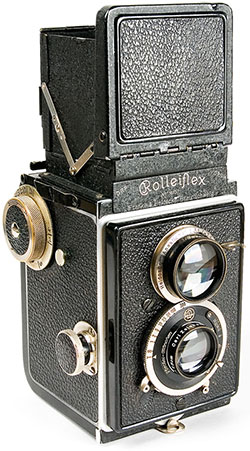
A type of camera that was popular in the first half of the 20th century. See Wikipedia: Twin-lens reflex camera.
2.5 Smartphone Cameras
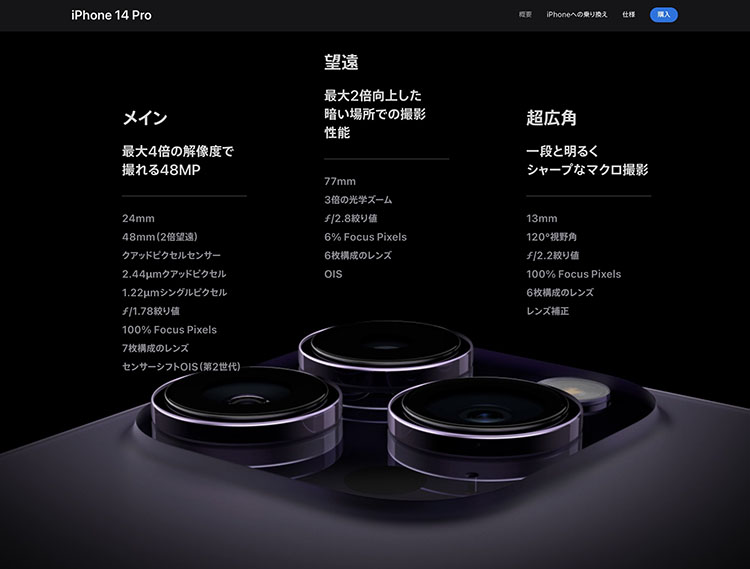
Since smartphones cannot be equipped with large lenses like those found in dedicated cameras, they incorporate multiple small lenses to enable wide-angle, standard, and telephoto photography. Many models now offer features that surpass those of dedicated cameras, such as higher-resolution image sensors, improved sensitivity, HDR photography, and LiDAR. By combining multiple lenses and various sensors and processing the data through software, they are now capable of producing images of a quality that rivals or even exceeds that of dedicated cameras.
(For reference)
3. Camera Technical Terms (Optical System)
Zoom (Optical)
There are two types of zoom: optical zoom and digital zoom. Digital zoom will be discussed later.
An optical zoom is a zoom lens
A lens consisting of a single element is called a “fixed-focus lens.” While it cannot zoom, it offers excellent light-gathering performance and high image quality.
Digital Zoom
Digital zoom is equivalent to post-processing in image editing software such as Photoshop, and results in a loss of image quality.
Focus
Autofocus, Manual Focus
F-number
Aperture
Depth of Field
(Reference)
- [Illustrated Guide] What Is Depth of Field? Its Relationship to Lenses and F-Stops | Includes Quick Reference Charts and Calculations!
- Calculating Depth of Field in Photography
Camera Technical Terms (Image Sensor and Digital Systems)
CCD (Image Sensor)
ISO Sensitivity
Shutter Speed (Still Images)
There is also a shutter speed for video, which is technically different
Exposure
Exposure compensation
Image Size and Resolution (Applies to All Videos)
Aspect Ratio
White Balance, Color Temperature
Tips for Composing Your Shot
Exposure
Degree of Blur
Degree of Blur
Sense of noise
3. Composition
Focal Length (Wide-angle, Standard, Telephoto, Macro)
Full shot, medium shot, close-up
Keep the subject within the frame
Eye Level
Overview
Road rage
Principles of Good Composition
4. Tripod
For information on tripods, see “How to Use a Tripod.”
Camera Work
Bread
Tilt
Zooming (Zoom In/Zoom Out)
Tracking
Shooting with a Stabilizer
Gimbal
5. Video Technical Terms
5.1 Frame
A unit of time less than one second. The number of frames in one second depends on the frame rate.