Turntable Based 3D Scan System
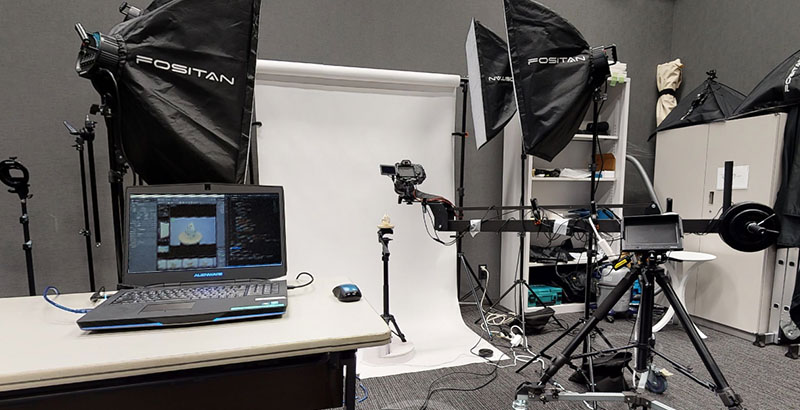
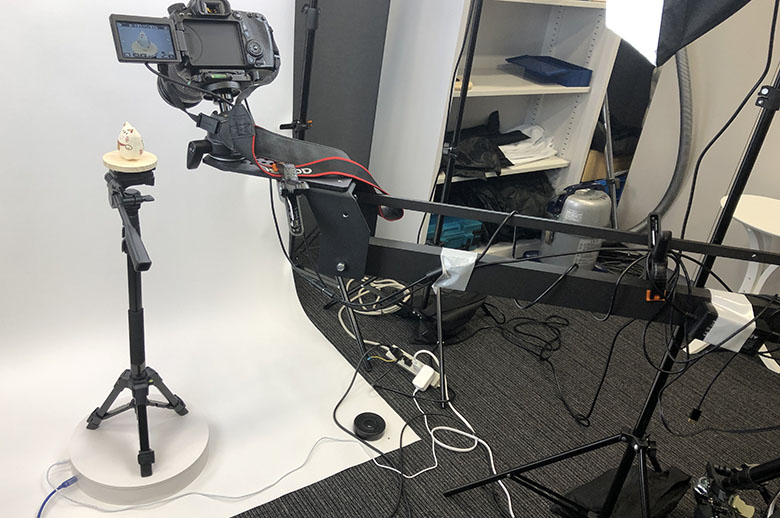
1. Turntable-type 3D scanning system
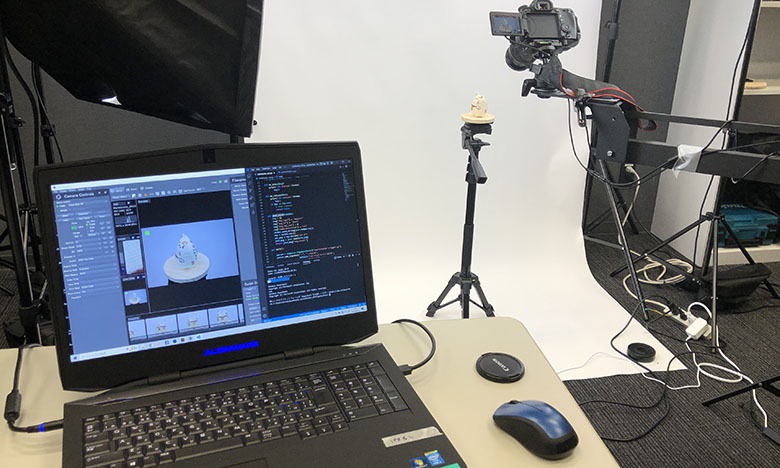
This article introduces our proprietary turntable-type 3D scanning system. The system consists of the following components.
- Control program (in-house Python development)
- Automatic turntable
- Tether Tool for camera control
- Photography crane
- Digital SLR camera
- Softbox lighting, roll-up background
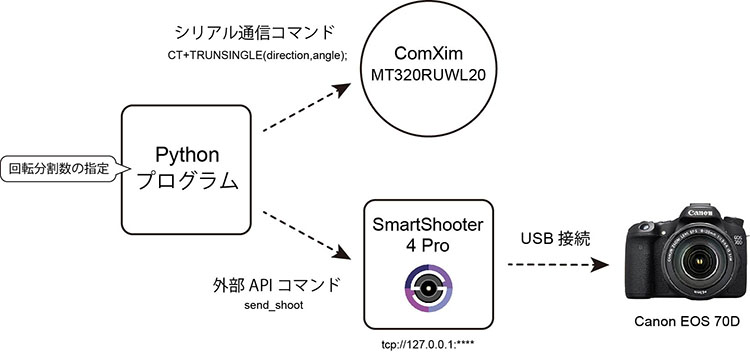
2. System Flow
3. Equipment Specifications
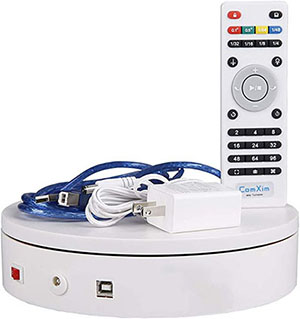
3.1 ComXim MT320RUWL20 (Automatic Turntable)
https://www.amazon.co.jp/gp/product/B079L1L5G8/
In addition to remote control, serial communication via USB allows for precise control of movements.
3.2 SmartShooter 4 Pro (Tether Tool for Camera Control)
https://tethertools.com/product/smart-shooter-4/
We used SmartShooter 4 Pro, a lower-tier version of CaptureGRID. It supports control of Canon, Nikon, and Sony DSLRs (digital single-lens reflex cameras).
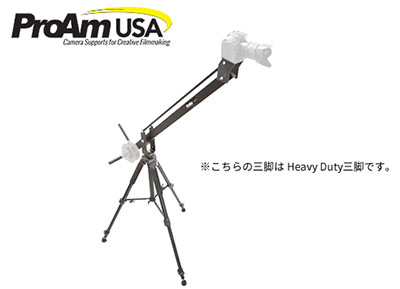
3.3 Film Cranes
- ProAm Orion Jr DVC60 1.24m Compact Camera Crane Basic Set
- ProAm Tripod Dolly TRIPOD DOLLY V2 (45kg Load Capacity)
3.4 Digital SLR Cameras
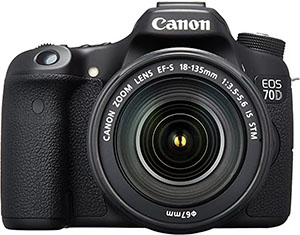
- Canon EOS 70D Lens Kit EF-S 18-135mm f/3.5-5.6 IS STM
To accommodate subjects of varying sizes, I chose a lens capable of covering wide-angle to medium telephoto focal lengths. It can capture images at a resolution of 5472 × 3648 at the highest quality setting. It costs around 60,000 yen used. It offers sufficient performance for photogrammetry.
4. Control Program (Custom-developed in Python)
4.1 Features
I developed a program using Python that can perform the following controls.
- Turntable control
- SmartShooter shutter control
4.2 Turntable Control
You can download the USB driver, Windows software (TurntableX.exe), and the manual from the Download page on the official Turntable website at the URL above.
For the turntable rotation control in this project, we used the command “CT+TRUNSINGLE(direction,angle);” described on page 4 of Secondary+development+guide.pdf. The direction is fixed at 0 (clockwise). You can change the number of rotation steps by entering an angle value for “angle.”
As part of the program’s specifications, the number of rotation steps (1/8 rotation, 1/16 rotation, 1/32 rotation, etc.) can be set via a variable. The shooting interval is calculated based on the number of rotation steps. While photogrammetric analysis is possible with approximately 1/16 rotation, for subjects that appear in the captured images only from a specific direction—such as holes or gaps—setting a finer number of rotation steps can improve the accuracy of the analysis.
4.3 Using the SmartShooter API
In addition to Python scripts that can be written within the SmartShooter application, it also supports command control via an external API. In this case, we needed to integrate with turntable control, but since we couldn’t add Python libraries (such as serial) to the application’s internal scripts (though there might be a way to do it), we’re controlling it via the external API.
- https://ssdocs.tethertools.com/external_api.html
- https://bitbucket.org/kuvacode/smartshooter-api/src/master/
In this instance, I used only commands related to shooting. While it is possible to have the camera autofocus automatically before shooting, this often resulted in the focus landing on unintended areas when the subject was rotating or was smaller than the base. For this reason, I manually set the focus to the center of the rotation axis each time I adjusted the camera position using the crane.
5. Photogrammetry Analysis Using Metashape
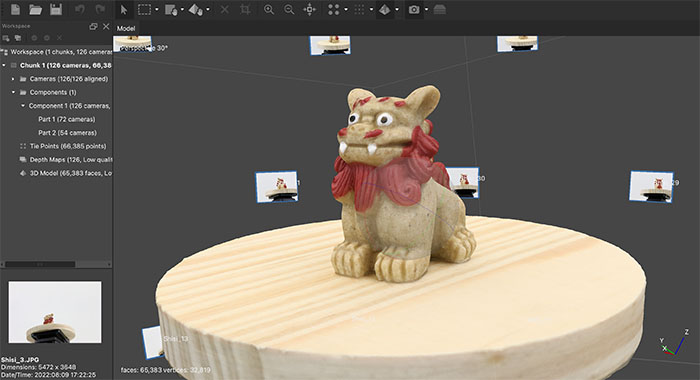
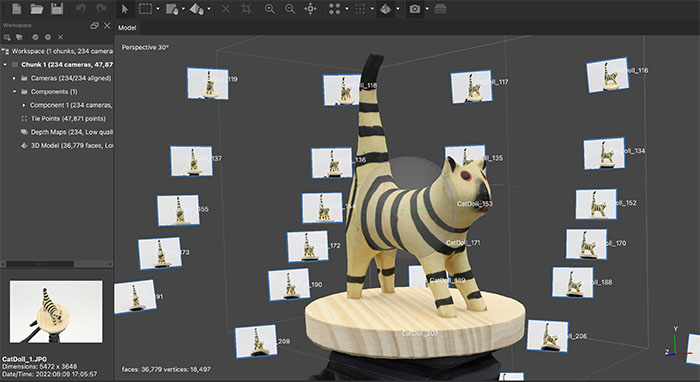
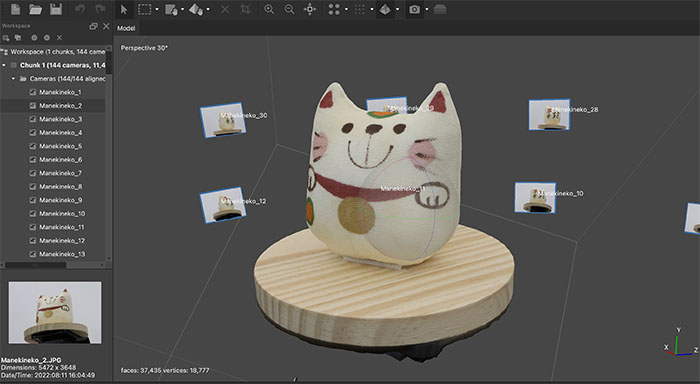
3D data generated using Metashape Standard. We will cover Metashape’s analysis methods in a separate article.
6. Comparison with Previous Development Systems
6.1 Multi-Camera + Turntable System
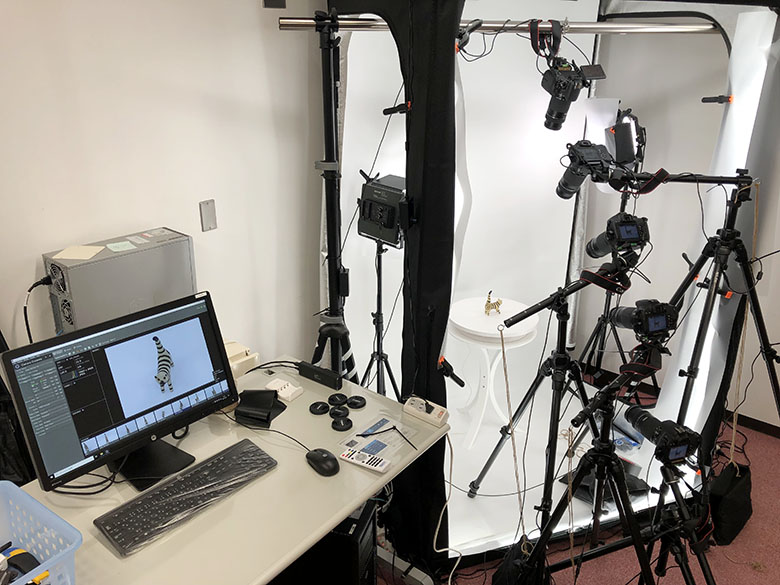
The figure below shows a turntable-style 3D scanning system using six digital SLR cameras that I developed while working at Kobe University of Art and Design (around 2021). Like the current system, it utilizes SmartShooter. The turntable did not have USB control functionality, so I had to manually operate both the Shoot button on SmartShooter and the remote control button on the turntable.
This system allows for automation using an automatic turntable and a Python program. One drawback is the effort required to adjust each of the six digital SLR cameras for each subject. In some cases, it may also be necessary to change lenses on all six cameras. As shown in the figure above, using approximately six cameras imposes limitations on where they can be placed, requiring them to be positioned at a certain distance from the subject. To fit as much of the subject as possible into the frame, we are using medium telephoto lenses.
6.2 Comparative Analysis
The newly developed system utilizes a single digital SLR camera and a crane, allowing the distance between the camera and the subject to be adjusted freely.
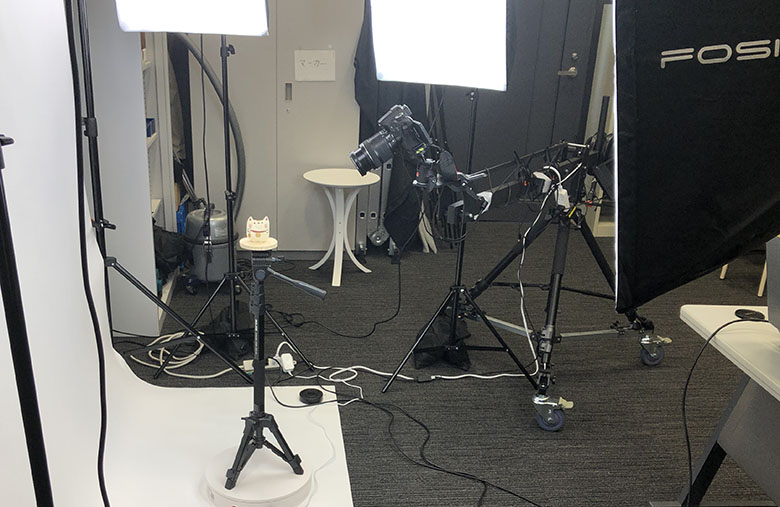
One drawback of the new system is that it requires crane and camera adjustments every time the turntable completes a full rotation, which results in slightly longer shooting times compared to using multiple cameras. On the other hand, the old system required adjusting multiple cameras for each subject.In contrast, if there is even a single adjustment error in the old system, the entire shoot must be redone. Since the new system allows for adjustments to be made on the fly, retakes are easier to handle, and the overall process results in fewer errors. Although verification is needed, it is expected that work efficiency will actually be higher than with the old system.
Furthermore, the number of vertical rows is virtually unlimited; based on the results of actual shooting tests, this system can achieve the same results as a setup with approximately 10 cameras. Therefore, it can be said that this system outperforms conventional setups not only in terms of shooting flexibility and cost-effectiveness but also in terms of analysis performance.
Based on the above discussion, I summarize as follows.
- For scanning large quantities of items of the same size, a system with multiple cameras is more efficient.
- For scanning different objects each time or increasing the scan resolution, a single-camera system combined with a crane offers greater versatility and lower setup costs.
7. Future Outlook
Although the crane used in this project is manually operated, if an automated crane equipped with a motor were integrated into the system, it would be possible to preset the camera position according to the size of the subject and build a fully automated photography system.
Since the objective of this study is to develop a 3D scanning system to serve as a tool for creating VR animations based on 3D scans of small dolls, building a full-scale system is not necessary; however, I would like to attempt experimental-level verification if the opportunity arises.